

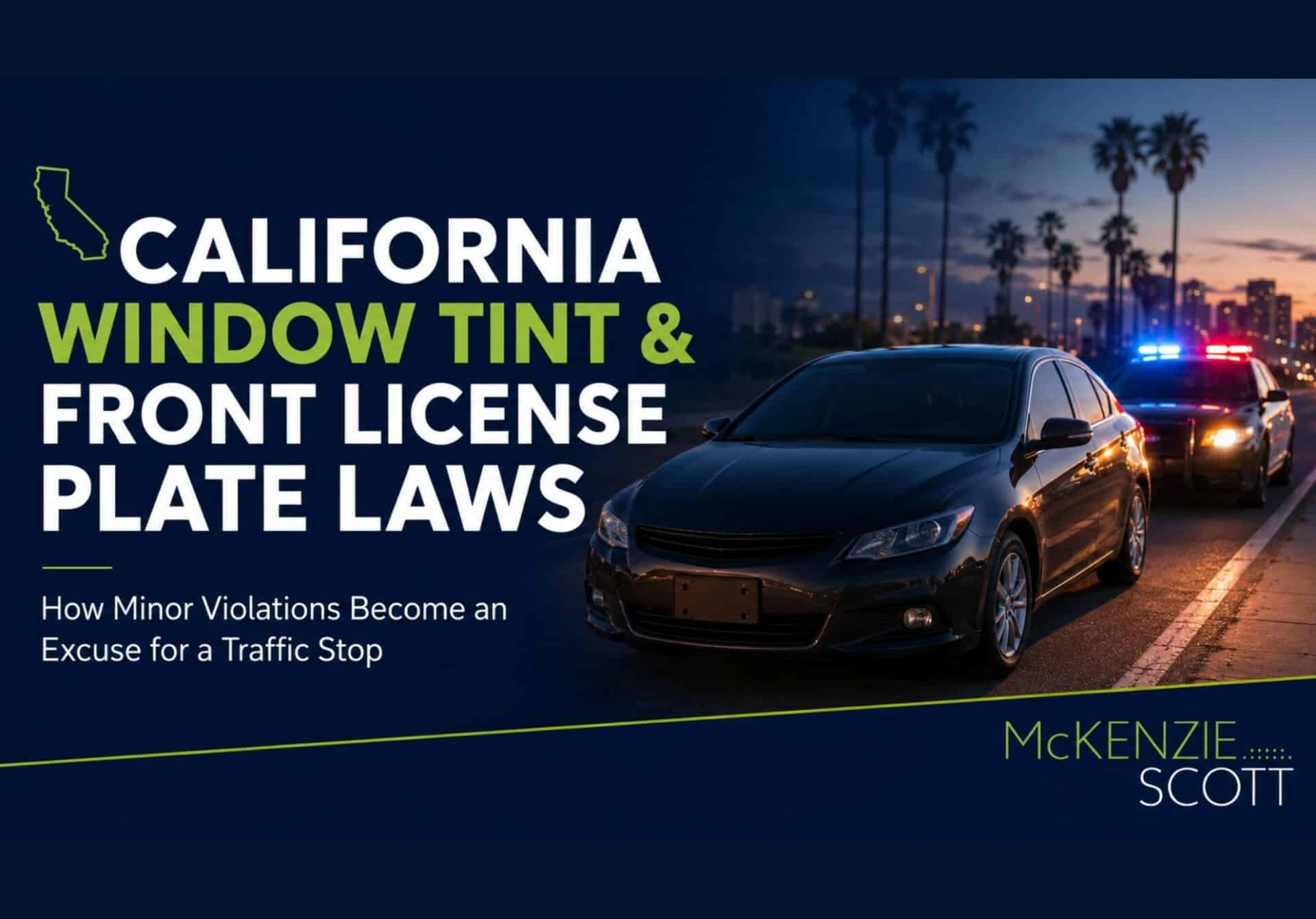
Driving through San Diego (or anywhere in California), it is easy to assume that a small vehicle infraction – like window tint that is a shade too dark or a missing front license plate – is not worth worrying about.
In reality, these minor violations are among the most common pretexts used by police officers for pulling drivers over, and data collected across California shows they are disproportionately used against Black, Latino, and other minority drivers. Understanding exactly what the law requires, and making sure your vehicle meets those requirements before you ever get behind the wheel, is one of the simplest and most effective ways to avoid an unwanted encounter with law enforcement or a “pretext stop.”
What is a Police Pretext Stop?
California’s Window Tint Law: What Vehicle Code 26708 Actually Requires
California’s window tint rules are set out in California Vehicle Code Section 26708 and they are fairly stringent. In the simplest terms, very little-to-no alteration is permitted on the windshield or front windows (driver’s and passenger’s). Under the law, the windshield generally cannot be tinted at all, except for a narrow strip of non-reflective tint along the top four inches, sometimes called an eyebrow strip.
The windshield and front driver and front passenger windows can have “clear, colorless, and transparent” material applied under certain conditions (i.e., it is necessary to block harmful UVA rays and a certificate kept in the vehicle or with the driver of the installer or manufacturer says the material blocks those rays or it is to block UVA rays and the driver/vehicle has a “certificate signed by a licensed dermatologist certifying that the person should not be exposed to ultraviolet rays because of a medical condition that necessitates clear, colorless, and transparent film material to be installed on the windshield, side, or rear windows”). If the front driver or passenger side windows have this “clear, colorless, and transparent” material affixed, it must allow more than 70% of light through.
Rear side windows and the rear windshield can be tinted to any darkness the owner prefers, although if the rear window is tinted dark enough to block a clear view through the rearview mirror, the vehicle must have functioning side mirrors on both sides. See the infographic below for more details.

Adhering to these specifications is where many otherwise careful drivers run into trouble. A large share of vehicles leave the factory with front windows that are already close to the legal limit, so even a small amount of additional material, including inexpensive do it yourself kits, can push the vehicle below 70% VLT and out of compliance. And, importantly, any material affixed to the front windows must be “clear, colorless, and transparent.” Most window tinting is just that—“tinted”—meaning colored and thus, out of compliance.
California does allow for “sun screening devices meeting the requirements of Section 26708.2 installed on the side windows on either side of the vehicle’s front seat, if the driver or a passenger in the front seat has in their possession a letter or other document signed by a licensed physician and surgeon certifying that the person must be shaded from the sun due to a medical condition, or has in their possession a letter or other document signed by a licensed optometrist certifying that the person must be shaded from the sun due to a visual condition.” But it is important to note that these “devices . . . shall not be used during darkness.” This means they must be removable.
Violations of Vehicle Code 26708 are typically treated as a fix it ticket. A first offense generally costs around $25, with 30 days to remove the illegal tint and have the vehicle reinspected before the citation is dismissed. Repeat violations can carry fines of up to $197 or more, along with additional court assessments.
The Front License Plate Rule Under California Vehicle Code 5200
Many California drivers assume the front license plate is optional, more of a courtesy than a requirement. It is not. Vehicle Code Section 5200 requires that when the Department of Motor Vehicles issues two plates for a vehicle, one must be attached to the front and the other to the rear. Vehicle Code Section 5201 further requires that plates be securely fastened, mounted so they are clearly visible, and kept legible at all times.
A violation of this requirement is an infraction that can carry a fine of $197 plus additional court costs. It is one of the easiest violations to avoid, since it usually only requires purchasing a proper mounting bracket and taking a few minutes to install the plate that came with the vehicle’s registration.
Why These Minor Violations Matter: The Pretextual Stop Problem
In 1996, the United States Supreme Court ruled in Whren v. United States that an officer may lawfully stop a vehicle for any traffic violation, no matter how minor, even if the officer’s real motivation is to investigate something else entirely. That ruling gave police broad legal cover to use small equipment violations, including tint that is slightly too dark or a missing front plate, as a basis to stop a driver they want to look at more closely.
California’s own Racial and Identity Profiling Advisory Board has studied this practice closely, and its findings are striking. A review of statewide stop data found that officers spent nearly 80,000 hours in a single year on traffic stops that resulted in no enforcement action at all, not even a warning or a citation. The board’s report concluded that pretextual stops for minor infractions are costly to the communities where they happen most often, and it recommended legislative reform.
In response, state lawmakers introduced Senate Bill 50, which would have barred officers from stopping a driver for a single minor issue, such as one broken taillight or the lack of a front license plate, unless it was paired with another violation. The bill ultimately failed to gain enough support to pass, which means that today, a tint violation or a missing front plate remains, on its own, a fully legal basis for a California traffic stop.
The practical consequence is that a routine equipment issue can turn into a much longer and more serious encounter. Once a driver is lawfully stopped, an officer has the opportunity to approach the vehicle, ask questions, request identification and documents, and in some cases request consent to search. What began as a fix it ticket can escalate quickly, and for minority drivers in particular, these encounters carry a disproportionate risk of misunderstanding, use of force, or worse.
How to Avoid Giving Police a Reason to Stop You
San Diego residents and Californians statewide can take a few straightforward steps to remove tint and license plate issues as a possible reason for a stop.
If your windshield or front driver or passenger side windows are improperly tinted, you can have the tint removed to avoid it becoming the basis of a traffic stop.
If you have a medical condition that requires windshield or front window alteration or a “sun screening device”, obtain a signed physician’s statement in advance and keep it in the vehicle at all times, not just on the day you expect to be stopped.
Install both the front and rear license plates that came with your registration, using a secure bracket, and make sure the plate is unobstructed and easy to read. A decorative frame that covers the state name, expiration sticker, or any digits can itself become a separate violation.
Periodically check the small details that officers commonly rely on for a stop: working headlights, taillights, and license plate lights, an unexpired registration tag, a secure front bumper, and a rearview mirror that is properly mounted if your rear window is tinted. Addressing a small equipment issue as soon as you notice it is far easier than dealing with the consequences of a stop after the fact.
What to Do if You Are Pulled Over Anyway
Even a fully compliant vehicle can still be stopped. If it happens, stay calm, keep your hands visible, and comply with the officer’s instructions. You are required to provide your license, registration, and proof of insurance, but beyond that you have the right to remain silent, and you are not required to consent to a search of your vehicle. You may politely ask whether you are free to leave. If you believe the stop was based on your race, ethnicity, or another protected characteristic, or that your rights were violated in any way during the encounter, write down everything you remember as soon as possible, including the officer’s name, badge number, patrol car number, and the exact sequence of events, and speak with a civil rights attorney promptly.
McKenzie Scott PC: Protecting Civil Rights Across San Diego and California
McKenzie Scott PC has been fighting for the little guy since 2000, representing clients across Southern California who have had their constitutional rights violated by government agencies. The firm’s civil rights practice takes on cases involving unlawful stops, discriminatory policing, and other violations of individual rights. Moreover, its police misconduct attorneys have secured some of the largest case results of their kind in California, including an $85 million civil rights verdict in a police in-custody death case, a $16 million jail death settlement (the largest wrongful death damages award in history paid by San Diego County), and a $1 million civil rights settlement (the largest payment of its kind in National City’s history).
If a traffic stop that began with a tint or license plate violation turned into something more – an unlawful search, an excessive use of force, a wrongful arrest, or worse – the experienced San Diego civil rights lawyers at McKenzie Scott PC are ready to investigate what happened and hold the responsible agency accountable.
Staying compliant with window tint and front license plate laws is one of the easiest ways to avoid giving police an excuse to pull you over. But if your rights were violated during a stop, contact McKenzie Scott PC today at (619) 794-0451 for a free case evaluation.